Detroit, Michigan
Bat in the House: What to Do First
A bat in the house is a health question before it is a removal question.
The first decision is whether the bat needs to be kept for rabies testing, and that decision belongs to a health department.
The steps below follow CDC, state and county guidance for Detroit, Wayne County and Oakland County.
Call about a bat in the house(313) 285-1517
Bat touched someone, or was in a room with a sleeper? Call the health department before anything else.
1. Decide whether anyone had contact
Contact means a bite, a scratch, or bare skin touching the bat. It also covers situations where you cannot be sure.
Federal guidance counts it as probable contact when a person wakes to find a bat in the room, or a bat turns up where people were sleeping.2
Bat bites can be tiny, and you may not know you were bitten.1
2. If contact is possible, keep the bat
Do not release it.1 Close the door to the room and keep children and pets out.9 Never touch a bat with bare hands.9
Oakland County's health division describes trapping the bat under a container, sliding cardboard beneath it and taping the cardboard on, then calling the health department about testing.3
Call about bats (313) 285-1517
3. Call the health department for where you live
| You live in | Call | Number |
|---|---|---|
| City of Detroit | Detroit Health Department, Communicable Disease program5 | 313-876-4000 |
| City of Detroit, public health emergency | Detroit Health Department6 | (313) 933-3437 |
| Wayne County outside Detroit | Wayne County Public Health8 | (734) 727-7000 |
| Oakland County | Oakland County Health Division, rabies exposure line3 | 248-858-1286 |
Numbers change, so check the agency page in the sources if one does not connect.
In Michigan, rabies testing of an animal that may have exposed a person is arranged through the local health department.4
Wayne County's health department says it accepts wildlife specimens that meet its rabies testing protocol.7
In Oakland County, help with getting an animal tested comes from the county's Animal Control office, reachable on 248-858-1090 in business hours.3
A quick test can spare you treatment.
The state health department notes that when testing happens within a day or two and the animal is not rabid, the patient may avoid medical treatment that was not needed.4
4. If there was no contact
When you are certain no one touched the bat and no one was asleep in the room, the National Park Service says to open doors and windows so it can leave.2
The Fish and Wildlife Service adds one tip for evenings: turn the indoor lights off so the bat can find the opening.9
Call about bats (313) 285-1517
5. Find out how it got in
County animal shelters do not do this part. Oakland County's shelter says its authority covers domesticated animals only.11
Tracing a bat back to a roost and closing the route is private work, and it is what Bat Removal Detroit takes calls about.
If bats keep appearing indoors, read bats in the attic next.
Why the caution, when so few bats are sick?
In the CDC's national breakdown of rabies in wild animals, bats come first at 35 percent, ahead of raccoons, skunks and foxes.10
Then ask why it was inside
Sometimes the answer is an open door.
The U.S. Fish and Wildlife Service notes that bats often fly in during the evening when an outdoor or garage light is drawing insects.9
A second or third bat in one season may point to a roost somewhere in the building.
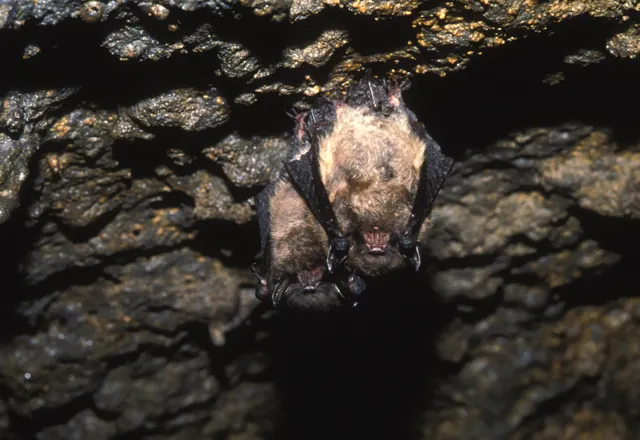
Little brown bats often use buildings for maternity sites, and attics are among the warm spots where a colony of two to more than a hundred females will gather.12
Detroit has plenty of candidates.
The median home in the city dates to 1947, and about 78 percent of its housing was built before 1960.13 Bats do not make holes.
They use gaps that are already there,9 and a quarter-inch opening is enough.1
Call about bats (313) 285-1517
Why Michigan takes bats seriously
Rabies in Michigan turns up in bats more than in any other animal.4
The state's 2026 map of rabies-positive animals showed 59 bats and one skunk as of October 29.14
Most bats are healthy; the U.S. Geological Survey puts the share that contract rabies at under one percent.15
The trouble is that you cannot tell which by looking, and a bite can be too small to notice.1
Short answers
I woke up and there was a bat in my room. Is that an exposure?
Treat it as one until a health department says otherwise.
The National Park Service lists waking up in a room with a bat as a probable contact, and Oakland County's health division advises treatment when someone has slept in a room where a bat was loose.
Should I let the bat out the window?
Only if you are sure nobody and no pet had contact with it.
If contact is possible, the CDC says not to release the bat until you have talked with a public health expert.
Sources
Sources
- CDC. Preventing Rabies from Bats.
- NPS (Office of Public Health). Responding to Bats in Buildings (PDF, version 23.2024).
- Oakland County Health Division. Rabies.
- MDHHS. Rabies.
- Detroit Health Department. Communicable Disease program.
- Detroit Health Department. Detroit Health Department.
- Wayne County Health Department. Rodents, West Nile, bedbugs and rabies.
- Wayne County Health, Human & Veterans Services. Contact Us (Public Health office).
- USFWS (Midwest Region Office of Communications). Five methods to safely remove a bat from your home.
- CDC. Rabies in the United States: Protecting Public Health.
- Oakland County Animal Shelter & Pet Adoption Center. Wildlife.
- USFWS. Little Brown Bat (Myotis lucifugus).
- U.S. Census Bureau. American Community Survey 2020-2024 5-year estimates, year structure built: Detroit, MI.
- MDHHS. Rabies Positive Animals in Michigan: 2026 (map).
- USGS. Are bats dangerous?.
Bats in the attic or the walls?
Call the line (313) 285-1517